Immersive Open Studio
Immersive Open Studio is a course-based, shared spatial-audio environment for public presentation of student work. Rather than each project building its own installation from scratch, a reusable audiovisual infrastructure — a multi-layer loudspeaker array, signal patching and camera-based interaction — is installed in a public venue, and groups develop their pieces directly inside it. The studio grew out of Spatial Audio I and Spatial Audio II, the two-semester curriculum on spatial music and media art.
The first run took place at The Underground Atlanta between October and November 2025, with weekly public showcases. Five student groups presented work within the shared infrastructure: Immerge, Since Everyone’s a DJ, Audenie, MACHINA, and Data Mirror: Fragmented Projections of Oneself — 16 students in total, ranging in aesthetic from ocean sonification to techno-futurism and short film.
Infrastructure
The system was first built as a three-layer loudspeaker array inside a former MARTA station tunnel: a top and middle layer of Neumann KH120 monitors and a bottom layer of QSC K10.2s and Alto subwoofers, with three projectors covering a 270° field. A MIDAS M32 served as the central mixer.
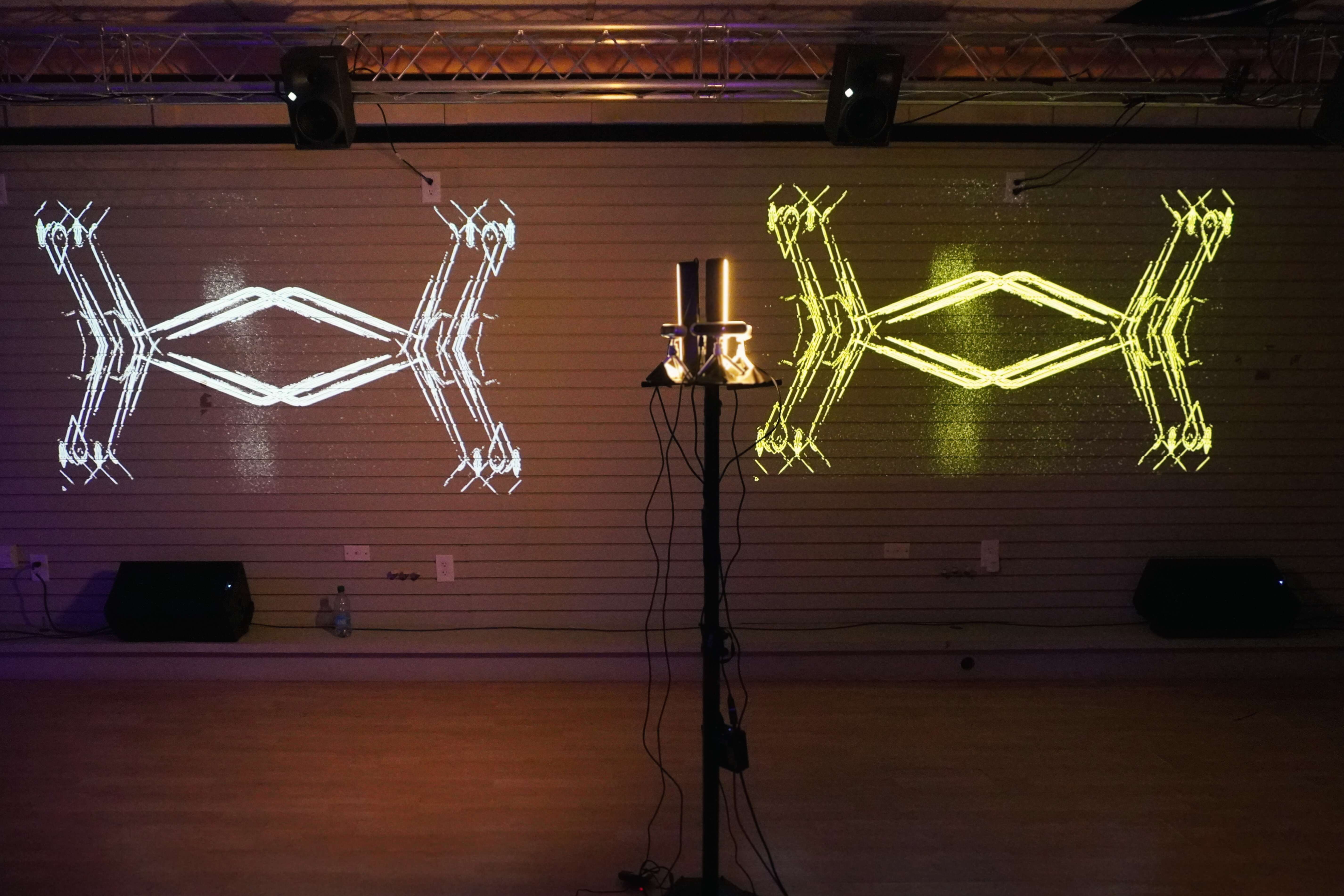
Three weeks in, flooding in the subterranean space forced an unplanned relocation to a second-floor room. The system was rebuilt there with a simplified two-layer speaker configuration and two parallel projectors, losing none of the loudspeakers in the move. The episode became part of the project’s own findings: a reusable spatial-audio platform has to be designed for relocation, not just for one venue.
Case Study: Since Everyone’s a DJ
One showcase, Since Everyone’s a DJ, is documented in depth as a case study for the studio concept. It lets up to four participants control a shared techno performance through camera-based body tracking, using four depth cameras to read hand gestures and position and drive a four-voice Ableton session with real-time Ambisonic spatialization and generative visuals. Audiences typically learned the interaction by watching others first, then joining in — a low-barrier entry point, though the specific mapping between gesture and sound stayed harder to read than the fact that something was responding at all.
Findings
Survey responses from students and observations across the showcases point to a few recurring themes: the tunnel’s length exaggerated depth and encouraged movement through the space, the loudspeaker array and gesture interaction supported a real sense of immersion, and audiences generally grasped that their movement affected the sound even when the finer mapping stayed opaque. Reflections also flagged room for clearer visual feedback and stronger cues inviting hesitant visitors to actually step in.
Publications1
Sunshiyu Wang, Changda Ma, Canting Zhu, Gibran Mobarak, Henrik von Coler: Immersive Open Studio: Shared Space, Shared Sound, Proceedings of the International Conference on New Interfaces for Musical Expression, 2026