Zerr~
Autogenous Spatialization
The Plugins
Zerr~ is a set of externals for autogenous spatialization, a channel-based approach that distributes a mono signal across arbitrary loudspeaker setups using the signal’s own properties as the control source. Audio features are extracted in real time and mapped to the geometry of the speaker array, so the sound decides where it goes. The name comes from the German Zerräumlichung — roughly, spatial disintegration.
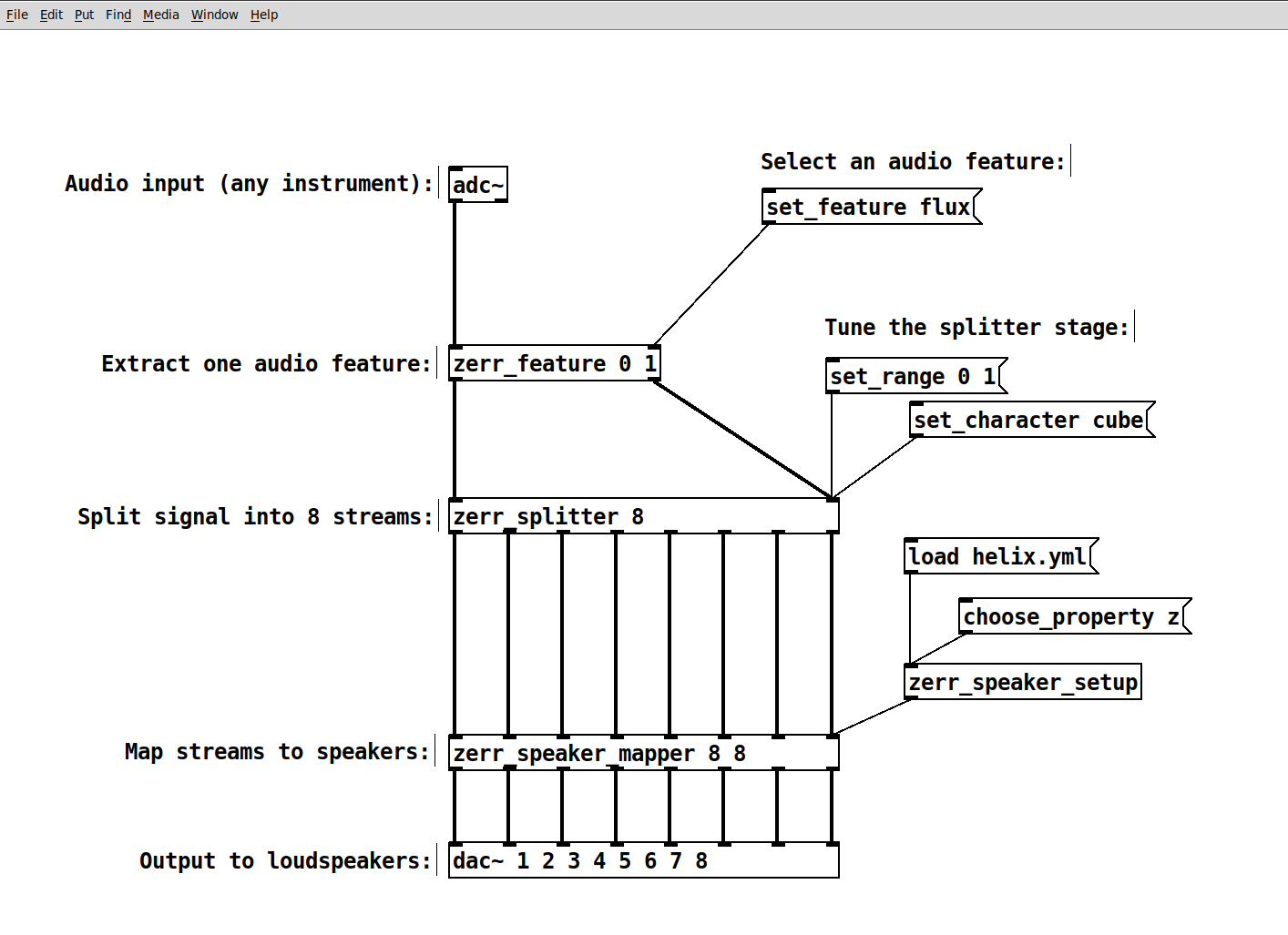
Both packages are fully functional. The Pure Data externals came first and
remain the more open environment for exploration; the Max externals use the
mc. multichannel objects and currently give the smoother patching
experience.
Pure Data: zerr_features~, zerr_envelopes~, zerr_disperser~,
zerr_combinator~
Max: mc.zerr.envelopes~, mc.zerr.combinator~, mc.zerr.disperser~,
mc.zerr.features~, zerr.features~
Performances
The approach was first used as a JACK client during the QuarantineSessions, with a virtual eight-channel setup rendered to binaural Ambisonics, and later tested in the studio on a 21-loudspeaker dome. An improvised study built entirely in Pure Data — modular synth patches routed through a send bus into several Zerr~ spatialization units — was premiered at PdMaxCon25 in Urbana-Champaign.
Zerr~ works best with simple synthetic material: filtered noise, basic waveforms, modulated sines. These have a direct connection to the extracted features, which keeps the control legible, while recorded sound tends to produce less rewarding artifacts.
Developed by Zeyu Yang and Henrik von Coler.
Publications2
Zeyu Yang, Henrik von Coler: Zerr~: Autogenous Spatialization in PD and Max, Proceedings of the Pure Data and Max Conference (PdMaxCon25), 2025
Zeyu Yang, Henrik von Coler: Autogenous Spatialization for Arbitrary Loudspeaker Setups, 2023 Immersive and 3D Audio: from Architecture to Automotive (I3DA), 2023